
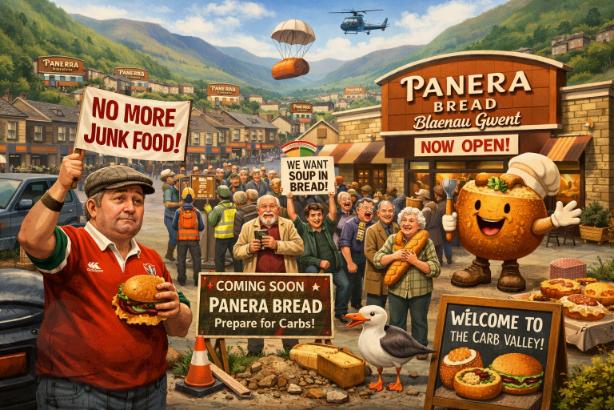
It started, as most revolutions do, with a man named Dai and a very disappointing cheeseburger.
Dai sat in his car outside the third takeaway he’d visited that week in Blaenau Gwent, staring at what could only be described as “a bun of regret.” The burger had the structural integrity of wet cardboard, the lettuce had clearly given up on life, and the sauce—well, nobody knew what the sauce was.
Dai took one bite, paused, and said out loud to no one in particular:
“Is this… even food anymore?”
That was the moment it all began.
🥪 The Petition Heard Round the Valleys
Within days, a WhatsApp group titled “Enough is Enough (And So Are Chips)” had 4,000 members. Residents shared photos of suspicious kebabs, existentially troubling pizzas, and chips that appeared to have been fried sometime during the Industrial Revolution.
Someone suggested a radical idea:
“Why don’t we get one of them fancy places… you know… with actual bread?”
“Like a bakery?” someone replied.
“No, no… posh bread. American posh bread.”
And that’s when the name was spoken for the first time:
Panera Bread.
There was a silence in the group.
Then someone typed:
“Do they do soup in bread?”
Another replied:
“They do soup inside bread.”
The group lost its collective mind.
🏗️ Operation Loaf Drop
What happened next baffled economists, confused local councils, and terrified nearby burger vans.
Within weeks, planning applications appeared. Then more. Then dozens. It was as if someone had pressed a giant “Bread Button” over Blaenau Gwent.
Where there had once been kebab shops, there were now construction signs reading:
“Future Site of Panera Bread – Prepare for Carbs.”
Even the council couldn’t keep up.
One councillor reportedly said:
“We approved one… then suddenly there were fourteen. I think the paperwork was… buttered.”
🥖 Opening Day Chaos
The grand opening of the first Panera Bread location was unlike anything the town had ever seen.
People queued from 5 a.m. Some brought camping chairs. One man brought a knife and fork “just in case things got civilised.”
Inside, staff calmly handed out sourdough, baguettes, and something called a “You Pick Two.”
Dai stepped forward, still shaken from his burger trauma.
“I’ll have… that soup… in the bread.”
When the bread bowl arrived, he stared at it like it was a miracle.
He dipped his spoon.
He took a bite.
He froze.
Tears welled up.
“It’s… it’s warm,” he whispered. “And the bread… it’s not collapsing.”
The crowd erupted into applause.
🍞 A Town Transformed
Within months, Blaenau Gwent had more Panera Bread locations than traffic lights.
People began using words like “artisan,” “crust,” and “notes of rosemary” in everyday conversation.
Former chip shop regulars now debated sourdough fermentation times.
One ex-burger enthusiast was overheard saying:
“I used to eat double cheeseburgers… now I pair soups.”
Even the local seagulls got confused.
“They won’t touch chips anymore,” said one resident. “They’re after focaccia.”
🧠 Academic Interest
Experts from across the UK began studying what became known as:
“The Blaenau Bread Shift.”
Some blamed fatigue with junk food.
Others pointed to the hypnotic power of a well-structured baguette.
One professor concluded:
“When a population reaches peak kebab, the only logical evolution is soup-in-bread.”
🏁 The Final Word
Back at the original car park, Dai now sat happily with a Panera sandwich, a fresh loaf beside him.
He looked out over the town—now dotted with bakery cafés instead of burger joints—and smiled.
“All we wanted,” he said, “was something that didn’t drip mystery sauce on your lap.”
He took another bite.
“And maybe a bit of dignity.”
And so, against all odds, Blaenau Gwent became the bread capital of Wales… proving once and for all:
You can take the town out of junk food… but you can’t take the bread out of the people.
What did you think of this story?
The Scrotumometer starts each story with lively starter scores. Your real vote is added on top.
Top reaction: 🥜 Lost Their Marbles